





Protons spotted at the edge of a nuclear breakup
Scientists studying nuclear fission have reported a new clue to what happens in the closing instants before a heavy nucleus divides. The research identifies rare emissions of protons that appear during the final stages of the split, when the nucleus briefly forms a narrow connection between two emerging fragments.
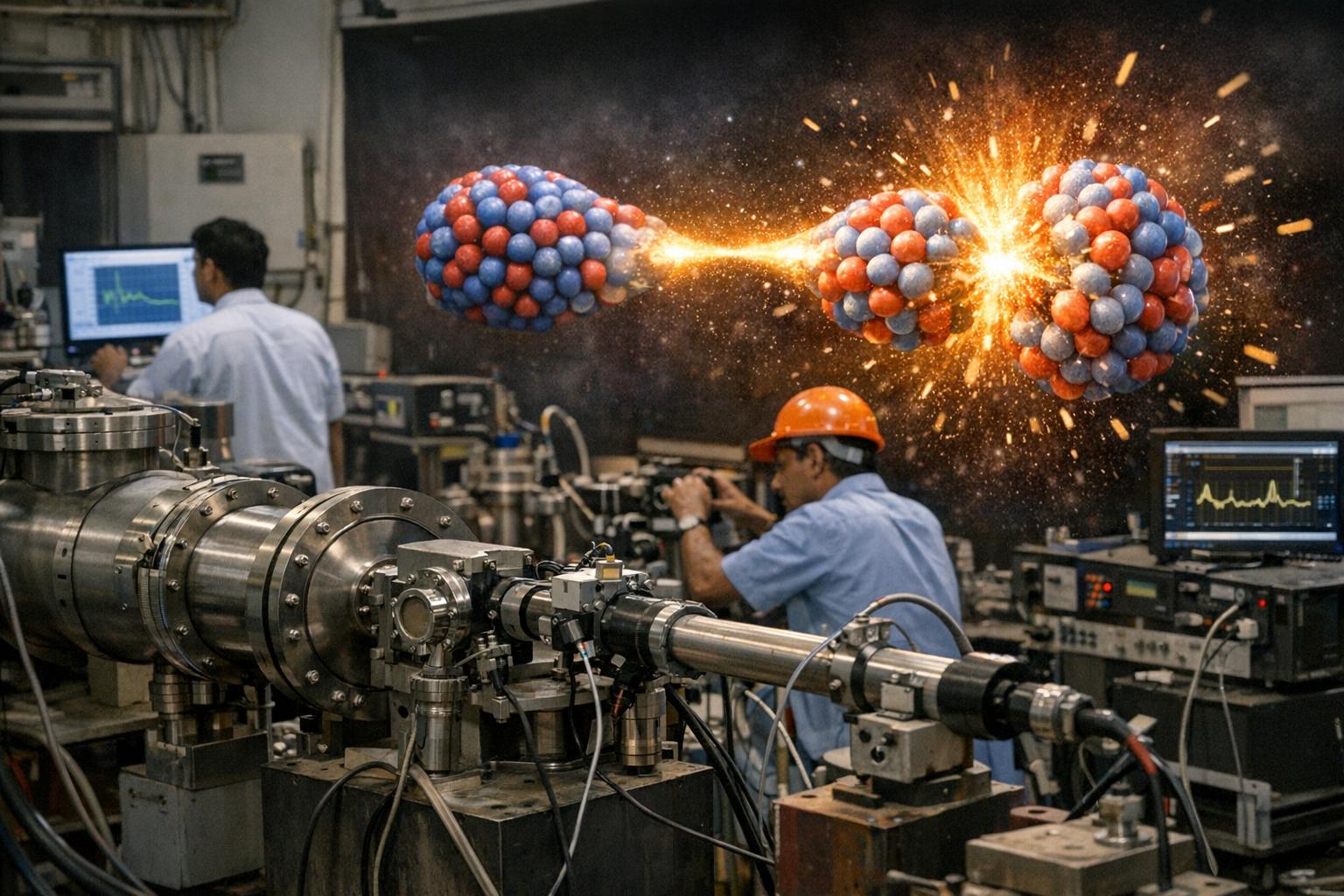
This thin connection, often described as a neck, stretches as the nucleus deforms. The study shows that uncommon proton signals can act as markers of how this neck evolves and when it finally snaps, offering a new window into a process that is otherwise difficult to observe directly.
A way to track the neck as it stretches and breaks
Nuclear fission is not an instant cut. As a nucleus heads toward division, it changes shape and passes through a highly dynamic phase. The team reports that the rare proton emissions carry information about this late, rapidly changing period, when the two parts are still connected by the neck but are already on the verge of separating.
By focusing on these proton events, the researchers could extract details linked to the last moments of deformation. The study describes this as a practical route to follow the neck’s stretching and the eventual rupture that completes the split.
Link to nuclear viscosity at extreme temperatures
Beyond mapping the breakup sequence, the work adds a new approach to studying nuclear viscosity. Viscosity, in this context, refers to how “sticky” nuclear matter is, or how strongly it resists rapid shape changes and flow when heated to extreme temperatures during fission.
Understanding this stickiness matters because it influences how energy is distributed in the system and how the final fragments and emitted particles emerge. The proton signatures highlighted in the study provide an additional handle to infer these properties, complementing existing methods.
Experiments at BARC facility and analysis method
The results are based on measurements carried out at the Bhabha Atomic Research Centre’s Pelletron LINAC facility. The researchers used a technique called Moving Source Disentangling Analysis to separate and interpret the different contributions to the detected emissions and isolate the specific proton signals of interest.
The study reports that this combination of rare proton observations and targeted analysis can help reconstruct key details of the fission endpoint, improving how scientists understand the transition from a stretched nucleus to two distinct fragments.