





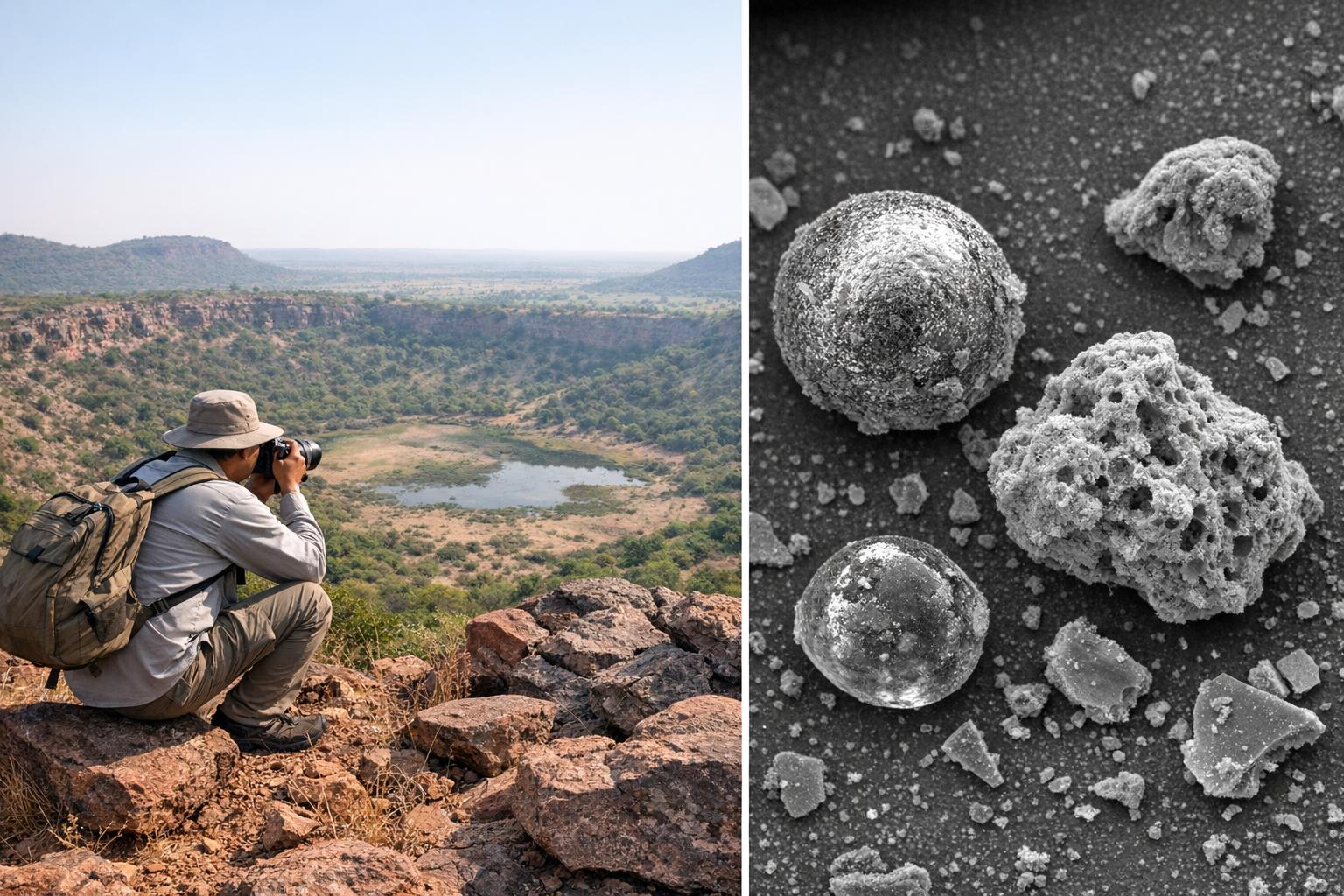
New evidence from tiny fragments
Microscopic particles are helping scientists build a clearer picture of the event that is believed to have created the Ramgarh crater in Rajasthan. The crater lies near Ramgarh village in Baran district in the state’s southeast, and it has long been linked to an ancient impact.
The latest findings, reported by India Today, highlight how small, hard to spot traces can carry important information about large cosmic events. Researchers are using these particles to understand more about the meteor and the conditions during the impact that shaped the landform.
Why Ramgarh crater draws scientific attention
Ramgarh is one of the better known circular geological structures in India. Its distinctive form and location have made it a point of interest for studies examining whether it was produced by an impact from space.
While the crater has been widely believed to be the result of an ancient meteor strike, establishing details such as the nature of the object involved and the processes that followed requires multiple lines of evidence. Tiny particles linked to the site are now being treated as another useful clue in that effort.
What the particles can reveal
Very small fragments and residues can retain signatures of the environment in which they formed. In impact studies, such materials may help indicate extreme conditions like high pressure and rapid heating, which can accompany a strike by a meteor.
By examining these particles, scientists aim to better understand the characteristics of the meteor believed to have caused the crater and refine the broader history of the impact. The approach also strengthens the scientific process of testing impact hypotheses through physical traces rather than relying only on the crater’s shape.
Location and significance
The Ramgarh crater is located near Ramgarh village in Baran district, southeastern Rajasthan. The site is often referenced in discussions about ancient impacts on the Indian subcontinent.
The new clues from microscopic particles add to ongoing work to document and explain the crater’s origin. Researchers continue to treat the structure as an important natural record that may help link India’s landscape to events beyond Earth.