





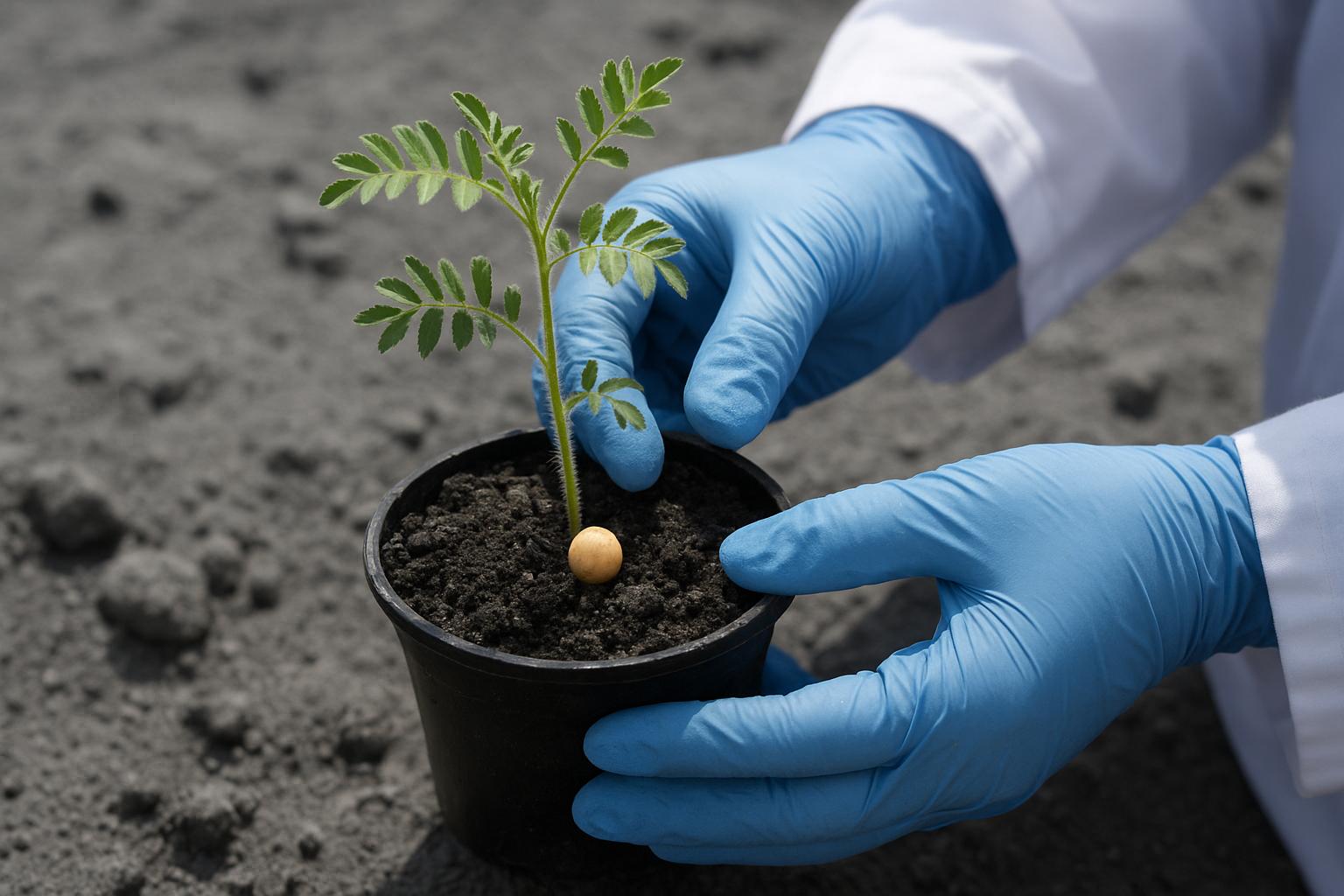
Growing food on the Moon has long been a key challenge for future lunar bases. Scientists at Texas A&M University have now shown that chickpeas can be cultivated in a soil mix designed to mimic the Moon’s surface, marking a fresh advance in efforts to support astronauts with locally produced nutrition.
The team carried out the work using a lunar soil simulant, a specially prepared material used on Earth to recreate the physical characteristics of Moon dust and regolith for experiments. By testing chickpea growth in this substitute, researchers can study how plants may respond in conditions similar to those expected on the Moon, without needing actual lunar samples.
Chickpeas are widely consumed across the world and are valued for their nutritional profile. For mission planners, crops that can deliver calorie-dense food along with protein are attractive candidates for sustaining crews during extended periods away from Earth. The successful growth of chickpeas in simulated lunar soil adds to the list of plants being explored for off planet agriculture.
According to the report, the Texas A&M effort is aimed at supporting sustainable food systems for astronauts on future Moon missions. Establishing dependable crop production is seen as an important part of reducing reliance on frequent resupply shipments from Earth, which are costly and limited by launch schedules.
Moon soil, unlike Earth soil, does not naturally contain the organic matter and living microbial communities that many crops depend on. Experiments with simulants allow scientists to examine what inputs plants may need, and how growth conditions could be adjusted in controlled environments such as habitat modules or greenhouses planned for lunar use.
The new result is part of a broader scientific push to develop practical life support systems for space exploration. Alongside oxygen and water management, food production is considered essential for long duration stays on the Moon and for testing technologies that could later be adapted for even more distant missions.
While the research is still at an early stage, the demonstration that chickpeas can grow in lunar soil simulant provides useful data for designing future experiments and refining methods for space based cultivation. Scientists continue to explore which crops can perform well under simulated lunar conditions and how to make harvests reliable for crew needs.