





What the study found
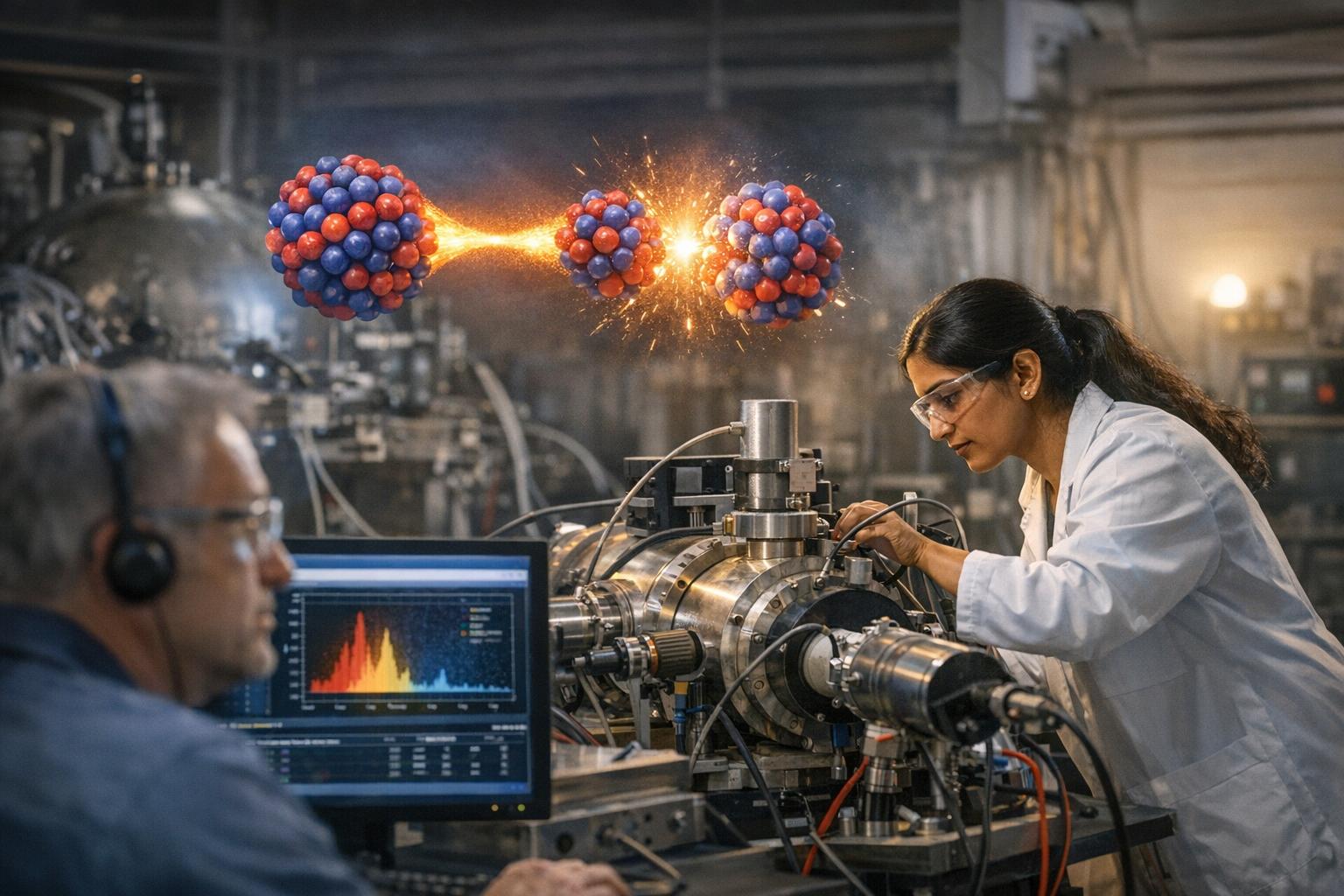
Researchers have reported evidence of rare proton emissions that shed light on the final moments before a heavy atomic nucleus splits in nuclear fission. The signals, captured and analysed in detail, indicate how a nucleus stretches into two parts connected by a narrow neck, and how that neck ultimately snaps to produce two fragments.
The study highlights that these proton emissions are uncommon, but valuable because they carry information from the brief transition phase right before scission, the point at which the nucleus breaks apart.
Why the “neck” matters in fission
In fission, a nucleus does not instantly divide into two separate pieces. It deforms first, taking on an elongated shape. As the deformation increases, a thin neck of nuclear matter forms between the emerging fragments. Understanding how this neck evolves is central to describing the dynamics of fission, including how energy and particles are released.
The new work connects the observed proton emissions to this neck evolution. By studying when and how these protons appear, the researchers say they can infer details of the stretch and snap process that is otherwise difficult to observe directly.
A window into nuclear “stickiness”
The research points to a new way of probing nuclear viscosity, a property often described as the internal friction or stickiness of nuclear matter. Viscosity influences how quickly the nucleus can change shape and how energy dissipates as it moves toward splitting.
According to the study, tracking these rare protons can help constrain how viscous nuclear matter is under extreme conditions, including very high temperatures reached during nuclear reactions.
How the data was studied
The findings draw on measurements and analysis methods designed to separate overlapping particle sources. The work used a technique referred to as Moving Source Disentangling Analysis to interpret the proton emissions and relate them to different stages of the reaction.
The study is linked to experiments conducted at the Bhabha Atomic Research Centre and its Pelletron LINAC Facility, where nuclear reaction studies are carried out using accelerated beams.
Why it is important
Fission remains a key process in nuclear science, with implications for reactor physics and fundamental research on how atomic nuclei behave. By providing a clearer picture of what happens just before scission, the study adds an experimental handle on a phase that is typically inferred rather than directly traced.
The researchers say the newly identified proton signatures offer a practical route to refine models of fission dynamics, especially those that depend on how nuclear matter flows and resists deformation at high excitation.