





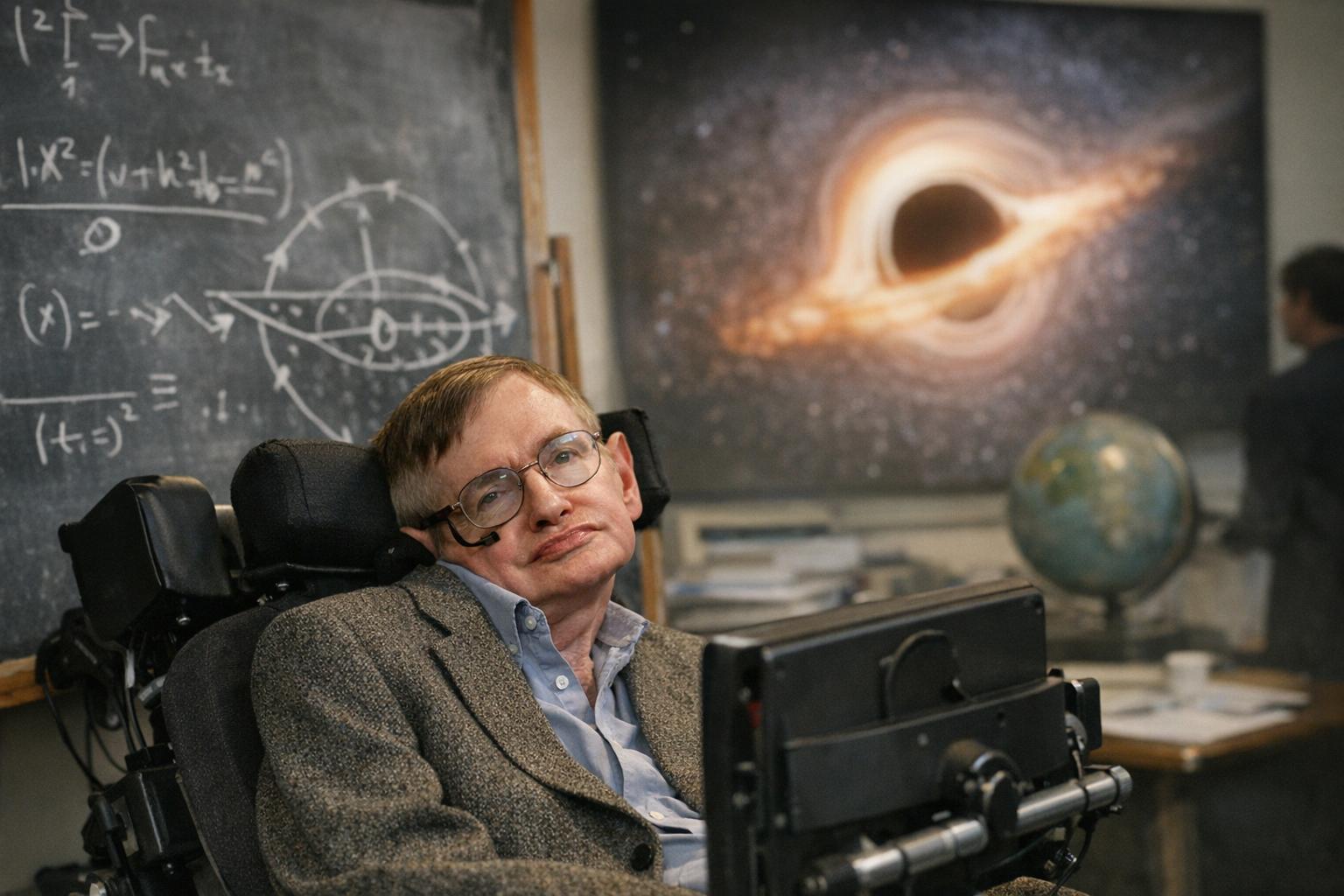
A turning point at 21
Stephen Hawking’s life changed dramatically when he was just 21. A diagnosis of ALS, a progressive neurological condition, came with a grim outlook. Yet the news did not end his ambitions. Instead, it became the moment that set the direction for the work that would make him one of the most recognised scientists of modern times.
Rather than stepping away from research, Hawking continued to build his academic career and deepen his focus on the biggest questions about the universe. Over time, he became known not only for his perseverance but also for ideas that pushed the boundaries of what physicists thought they understood.
Rewriting what we know about black holes
Hawking’s most famous contributions centred on black holes, objects so dense that their gravity affects everything around them. His research questioned established assumptions in physics and opened fresh debates about how the universe works at its most extreme edges.
By bringing new thinking to black holes, Hawking helped shift the conversation in cosmology and theoretical physics. His work influenced how scientists study the relationship between gravity and the fundamental laws that govern matter and energy.
Impact beyond the laboratory
Hawking’s story resonated far beyond scientific circles. Living with ALS while remaining active in research made his career a symbol of determination. His scientific achievements, paired with his personal journey, drew attention from people who might otherwise never have followed developments in cosmology.
Across the world, Hawking’s discoveries and his public presence helped turn complex topics into subjects of mainstream interest. Millions were introduced to the mysteries of the universe through the questions his work raised about space, time, and the nature of reality.
A legacy shaped by resilience and discovery
Hawking’s early diagnosis did not define the limits of his life’s work. Instead, it marked the beginning of an extraordinary period of discovery that changed how black holes are discussed in modern physics.
His journey remains closely associated with a simple fact: the life altering moment at 21 became the starting point of his greatest scientific contributions, leaving a lasting imprint on our understanding of the universe.